Customer Testimonial
Don't take our word for it!

ES West Turkey
Operator, Turkey
"The installation was smooth, the cement job was excellent, and the final bond log confirmed we made the right choice."
Read more...Guyana’s offshore expansion continues to create new milestones. In August 2026, MODEC announced the arrival of Errea Wittu, the floating production, storage and offloading vessel for the Uaru development. The announcement marked another step in the growth of the Stabroek Block.
The well construction behind that growth is substantial. ExxonMobil’s announced Uaru development plan included 44 production and injection wells across up to 10 drill centers. At that scale, the ability to plan and execute casing runs consistently deserves attention alongside production capacity
For centralization, this means evaluating the complete path to setting depth: casing and connection dimensions, restrictions, well trajectory, running forces and the standoff required for cement placement.
Centek is not approaching Guyana as a new market. The company has supported offshore operations there since the early exploration campaigns that preceded today’s development program, supplying centralizers and stop collars across complete casing strings.
Alongside field supply, Centek has provided well-specific simulations for Guyana wells to compare product and spacing options, predict standoff and running forces, and identify the most appropriate solution for each section. This helps reserve specialist close-tolerance products for the intervals that demand them while identifying more cost-effective options for less challenging sections.
Centek’s direct experience in Guyana is reinforced by field evidence from other offshore regions, providing practical examples of how specific well-construction challenges have been addressed.
In the Gulf of Mexico, an operator needed to run a 13 3/8-in. liner through a subsea wellhead in more than 8,000 ft of water. The liner also had to pass through a 14 3/4-in. drift restriction. Fifteen UROS-CT centralizers were installed offline before shipment to the rig. The liner reached more than 12,500 ft at 70° inclination, after which the annulus was circulated clean and cementing proceeded as planned. Gulf of Mexico case study
This example demonstrates why the restriction itself must be considered during selection, including the centralizer’s installed profile and its ability to withstand passage through the constrained section.
Offshore Uruguay, the challenge included uncertainty over the final casing program. An exploratory well might require a 16-in. contingency liner, which would introduce an additional restriction for the subsequent 13 5/8-in. casing string.
UROS-CT centralizers were selected to accommodate either configuration. More than 20 were installed offline, and the casing reached total depth and was cemented successfully. Centek reports savings exceeding US$250,000 across the centralization solution for the 13 5/8-in. and 9 7/8-in. strings. These were project-specific savings, illustrating the potential value of reviewing alternative configurations early. Uruguay case study
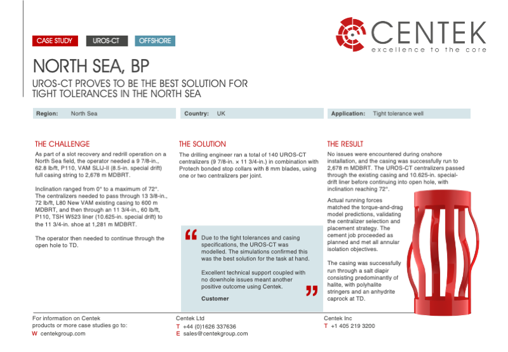
The UK, North Sea provides evidence of the connection between planning and field performance. In a slot-recovery and redrill operation, 140 UROS-CT centralizers were run on a 9⅞-in. casing string through restricted clearances and inclinations reaching 72°. Running forces matched the torque-and-drag model, the casing reached depth without problems, and the cement job met the annular isolation objectives. North Sea case study
A Danish application provides a further example. An 11¾-in. liner had to pass through casing with a 12 1/4-in. drift in a well inclined at approximately 64°. The solution used 28 TUR-CT centralizers and 56 slim stop collars. Torque-and-drag analysis supported deployment planning, while separate iCem fluid-flow modeling assessed cement displacement. The liner was run within the simulated parameters. Denmark case study
These operations represent different geological settings and well designs. They do not substitute for Guyana experience; they extend it, showing how comparable engineering questions have been solved across other offshore basins. The key questions remain: can the equipment pass the planned restrictions, provide the required standoff and deliver manageable running forces?
For Guyana’s offshore casing programs, Centek’s UROS and TUR families cover under-reamed and close-tolerance applications, while S2 supports other demanding casing-running requirements. For less challenging sections, the new ES single-piece bow spring centralizer provides a more economical option, paired with the low cost stop collar. Simulation connects these product capabilities to well economics, helping operators avoid a one-product-fits-all approach and select the most cost-effective solution for each section.
As Guyana moves from exploration-led activity into a sustained multi-well development program, Centek brings continuity: established in-region supply, complete-string centralization support and well-specific simulation backed by field evidence from other offshore basins.
Planning your next casing string offshore Guyana? Build on Centek’s in-region experience with a free simulation.
Compare centralizer and spacing options, assess predicted standoff and running forces, and identify where high-performance equipment is required—or where a more cost-effective solution can meet the demands of a less challenging section.
Submit your well details to request a tailored Centek simulation and receive expert product recommendations for your application.
"The installation was smooth, the cement job was excellent, and the final bond log confirmed we made the right choice."
Read more...