THE CHALLENGE
Customers in the Rockies are utilizing different production liner and production casing well design techniques to complete their wells.
They are looking for ways to have more productive wells that last longer without remedial intervention and repair. In this region we see a major difference in choice of cementing versus non-cemented drilling an completion applications. For operators who have chosen the cemented completion design, we have demonstrated the field proven added value of using Centek centralizers.
In this example operators were concerned with achieving 3 goals during the primary cementing process;
- Getting casing to bottom
- Have the ability to rotate casing
- A satisfactory bond log result
THE SOLUTION
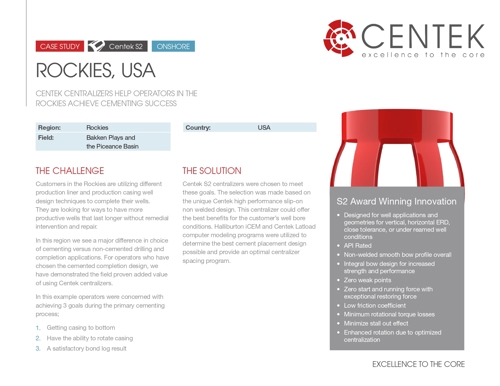
Centek S2 centralizers were chosen to meet these goals. The selection was made based on the unique Centek high performance slip-on non welded design. This centralizer could offer the best benefits for the customer’s well bore conditions. Halliburton iCEM and Centek Latload computer modeling programs were utilized to determine the best cement placement design possible and provide an optimal centralizer spacing program.
THE RESULT
The Bakken Well
The Bakken well in this case history was 20,000ft MD. The centralizer design was to run 471 x 4 1/2” x 6 1/8” Centek S2s. This was to match a previous well placement comparison where plastic polymer centralizers were run. Typical rigid centralizers are built to be under hole gauge. The Centek S2 is made to hole gauge and offers semi-rigid bow spring performance and offer better stand-off.
The operator ran 2 x S2 centralizers per joint in the curve and lateral. The string reached total depth without issue.
The Piceance Well
In the Piceance well, the operator chose to run the Centek S2s on the 4 1/2” x 6” casing in their first horizontal well in the Piceance Basin (Grand Junction area). It was a deep lateral to about 12,000ft MD in the Niobrara formation.