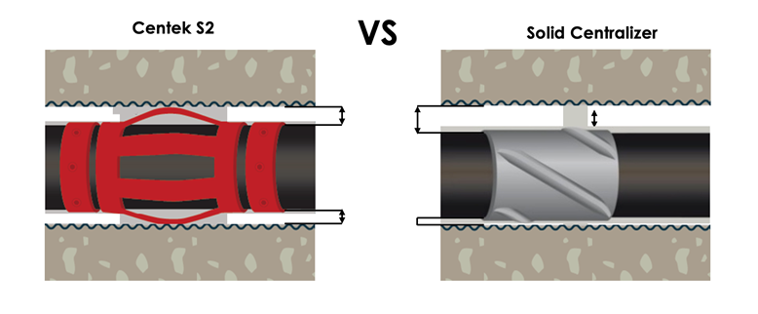
To understand why flow by area is lower for a solid body centralizer compared to a bow spring centralizer, let's first define what flow by area means in the context of centralizers:
Flow by area refers to the ability of fluids (such as drilling mud or cement slurry) to flow around a centralizer and between the centralizer and the wellbore wall. This flow is critical during running casing and cementing operations as it helps reduce annular pressure impacts and improves coverage of cement around the casing or liner, promoting effective zonal isolation and wellbore integrity.
Now, let's examine why flow by area is lower for a solid body centralizer compared to a bow spring centralizer:
- Design and Construction: Solid body centralizers have a compact and continuous design, with minimal open space between the centralizer and the casing or liner. In contrast, bow spring centralizers feature a spring-like design with curved metal blades that create open channels or gaps between the centralizer and the wellbore wall. This design difference significantly impacts the flow area available for fluids to pass through.
- Contact Surface Area: Solid body centralizers typically have a larger contact surface area with the casing or liner compared to bow spring centralizers. The increased contact surface area reduces the available space for fluid flow around the centralizer, limiting the flow by area.
- Fluid Passage Restrictions: The solid construction of a solid body centralizer creates more significant barriers to fluid passage compared to the open gaps or channels in bow spring centralizers. As a result, fluids encounter greater resistance when flowing around a solid body centralizer, leading to lower flow rates and reduced flow by area.
- Frictional Resistance: Solid body centralizers may generate higher frictional resistance against the casing or liner and the wellbore wall compared to bow spring centralizers. This increased frictional resistance further impedes fluid flow and reduces the flow by area.
In summary, flow by area is lower for a solid body centralizer compared to a bow spring centralizer due to differences in design, construction, contact surface area, fluid passage restrictions, and frictional resistance. While both types of centralizers play critical roles in wellbore operations, operators must consider these factors when selecting centralizers to ensure optimal fluid flow and cement coverage during cementing operations.
Centek made to gauge bow spring centralizers outperforms under gauge solids in horizontal sections. As well as increasing flow by area, benefits include maximizing standoff and limited well bore interaction. Solid centralizers run in hole under gauge and limit standoff. The profile, inflexibility and interaction with the wellbore will increase torque and drag and can damage filter cake.