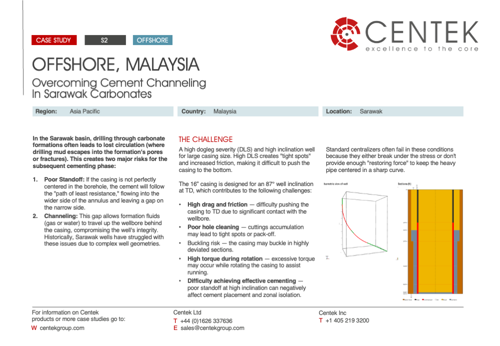
In the Sarawak basin, drilling through carbonate formations often leads to lost circulation (where drilling mud escapes into the formation's pores or fractures). This creates two major risks for the subsequent cementing phase:
1. Poor Standoff: If the casing is not perfectly centered in the borehole, the cement will follow the "path of least resistance," flowing into the wider side of the annulus and leaving a gap on the narrow side.
2. Channeling: This gap allows formation fluids (gas or water) to travel up the wellbore behind the casing, compromising the well's integrity. Historically, Sarawak wells have struggled with these issues due to complex well geometries.
THE CHALLENGE
A high dogleg severity (DLS) and high inclination well for large casing size. High DLS creates "tight spots" and increased friction, making it difficult to push the casing to the bottom.
The 16” casing is designed for an 87° well inclination at TD, which contributes to the following challenges:
- High drag and friction — difficulty pushing the casing to TD due to significant contact with the wellbore.
- Poor hole cleaning — cuttings accumulation may lead to tight spots or pack-off.
- Buckling risk — the casing may buckle in highly deviated sections.
- High torque during rotation — excessive torque may occur while rotating the casing to assist running.
- Difficulty achieving effective cementing — poor standoff at high inclination can negatively affect cement placement and zonal isolation.
Standard centralizers often fail in these conditions because they either break under the stress or don't provide enough "restoring force" to keep the heavy pipe centered in a sharp curve.
THE SOLUTION
To address these issues, the engineering team selected the Centek S2 1338-1600S single-piece bow-spring centralizer. Its design offers specific advantages for this environment:
- Robust Single-Piece Construction: The S2 is machined from a single piece of steel, meaning it can take the high-stresses during trip down a high-DLS wellbore.
- Superior Standoff: It provides high restoring force, ensuring the 13 3/8" casing stays centered even in deviated sections, which is critical for a uniform "annular sheath" of cement.
- Reduced Drag: The Centek S2 unique design minimizes the force needed to push the casing into the hole (low "starting and running forces"), which was essential for this challenging Sarawak profile.
THE RESULT
Despite the initial drilling challenges and fluid losses, the Cement Bond Log (CBL) evaluation indicated the presence of highly competent cement behind the casing.
Based on this success, the client has standardized the use of the Centek S2 for all future wells in similar carbonate or loss-circulation zones.